Sciatica and a herniated disc are terms that patients and providers sometimes use interchangeably. They are related, but they describe different things, and treating them as identical leads to treatment plans that are less precise than they should be.
Understanding the distinction and knowing how a pain management specialist evaluates each is useful for anyone dealing with lower back pain, radiating leg pain, or symptoms that have persisted beyond what initial treatment resolved.
What a Herniated Disc Actually Is
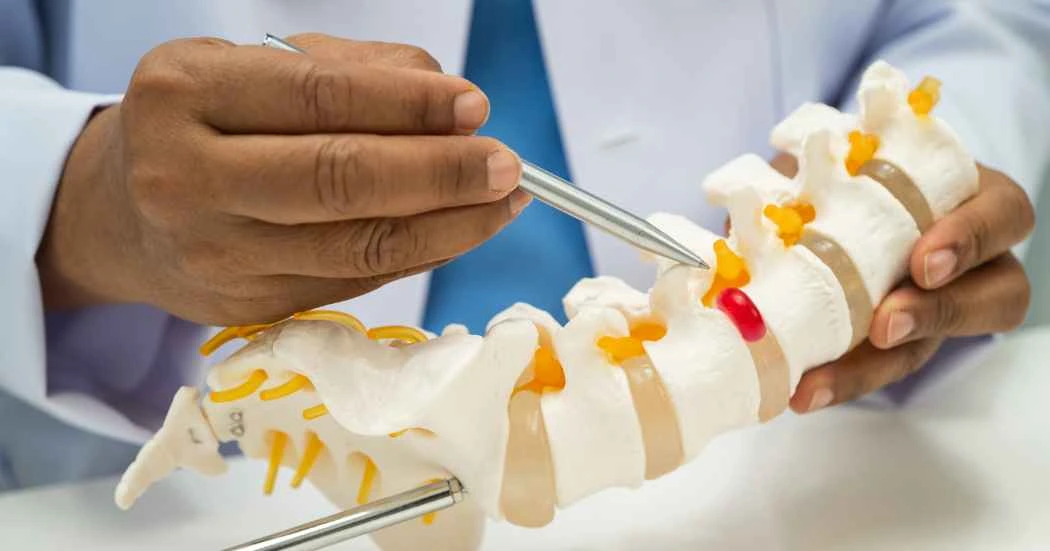
The spine is made up of vertebrae separated by intervertebral discs. Each disc has a tough outer layer, the annulus fibrosus, and a gel-like interior, the nucleus pulposus. A herniated disc occurs when the interior material pushes through a tear in the outer layer.
That herniation itself does not always produce symptoms. Many people have herniated discs that are identified incidentally on imaging without causing pain. The disc becomes clinically significant when it presses against a nearby nerve root as it exits the spinal canal. At that point, the compression causes symptoms not just at the disc level but along the entire pathway of the affected nerve.
The most common sites for lumbar disc herniation are L4-L5 and L5-S1, which correspond to the nerve roots that feed into the sciatic nerve.
What Sciatica Is
Sciatica is a symptom pattern, not a standalone diagnosis. The term describes pain, tingling, numbness, or weakness that radiates from the lower back through the hip and down one leg, following the path of the sciatic nerve. That nerve is the largest in the body, originating from several lumbar nerve roots and running through the buttock and down the leg to the foot.
A herniated disc is one of the most common causes of sciatica, but it is not the only one. Spinal stenosis, piriformis syndrome, degenerative disc disease, and facet joint inflammation can all produce sciatic-pattern symptoms through different mechanisms. A patient can have sciatica without a herniated disc, and they can have a herniated disc without sciatica.
This is why identifying which structure is generating the symptoms changes what treatment is appropriate.
How Specialists Tell Them Apart
Clinical evaluation begins with the symptom pattern. Sciatica typically presents as pain that travels in a defined line from the lower back or buttock down through the thigh, calf, and sometimes into the foot. It is usually one-sided. Symptoms often worsen with sitting, bending forward, or activities that load the lumbar spine, and may ease when lying down.
A herniated disc specifically tends to produce symptoms that are sharp and positional, varying significantly with movement and body position. Symptoms from spinal stenosis, by contrast, often worsen with standing and walking rather than sitting.
MRI of the lumbar spine is the standard imaging study to confirm disc herniation and identify which nerve root is involved. Electrodiagnostic testing, including nerve conduction studies and electromyography, can assess how the nerve is functioning and whether there is active nerve damage beyond compression.
At Premier Pain Management, the evaluation combines clinical examination findings with imaging to determine both what is generating the pain and what treatment pathway is most appropriate given the specific mechanism.
How Each Is Treated
Treating a Herniated Disc With Nerve Compression
When a herniated disc is confirmed as the source of nerve compression, epidural steroid injections deliver anti-inflammatory medication directly to the affected nerve root. This reduces the inflammation and swelling that contribute to the pain signal, often providing significant relief while the disc-related irritation resolves.
For patients whose symptoms have not responded to injections, or where disc-related compression involves mechanical loading of the spine, decompression therapy can reduce the intradiscal pressure that is driving the herniation against the nerve. This is a non-surgical approach that creates negative pressure within the disc to encourage retraction of herniated material.
Where the condition involves significant disc degeneration or structural instability that has not responded to interventional care, surgical consultation may be appropriate. Premier Pain Management evaluates surgical necessity as part of the overall treatment planning process.
Treating Sciatica When the Source Is Not Disc-Related
When sciatica is driven by a cause other than disc herniation, the treatment is targeted to that mechanism. Piriformis syndrome, where the piriformis muscle is compressing the sciatic nerve outside the spine, may respond to targeted physical therapy, trigger point injections, and physical medicine and rehab that addresses muscle tension and hip mechanics.
Spinal stenosis-related sciatica may be managed with epidural injections for acute relief, alongside chiropractic care and physical medicine approaches that focus on maintaining spinal mobility and reducing loading on the narrowed canal.
In all cases, the treatment is selected based on what the evaluation identifies as the generating structure, not based on the symptom pattern alone. Two patients with nearly identical sciatica symptoms may require meaningfully different treatment plans depending on what is causing the nerve irritation.
When to Seek Evaluation
Lower back pain with leg involvement that has persisted for more than a few weeks, that is worsening, or that includes neurological symptoms such as leg weakness, significant numbness, or loss of bladder or bowel control warrants specialist evaluation. The last of these requires urgent assessment.
Pain that has been managed conservatively without improvement after four to six weeks, or that has responded to treatment but keeps returning, is also appropriate for specialist evaluation. Understanding what is generating the pain changes the approach and typically produces better outcomes than continued general management.
Depending on the source of the symptoms, interventional pain procedures may be part of a coordinated plan to reduce inflammation, relieve nerve irritation, and improve function without unnecessary surgery.
Premier Pain Management serves patients across Phoenix, Maryvale, Mesa, and Queen Creek. Same-day appointments are available with no referral required.
If you are dealing with radiating leg pain, lower back pain, numbness, tingling, or suspected disc-related nerve pain, schedule an appointment with Premier Pain Management for a focused evaluation.
Premier Pain Management provides evaluation and treatment for sciatica, herniated disc, lumbar radiculopathy, and related spinal conditions at clinics in Phoenix, Mesa, and Queen Creek, Arizona.
